There was a recent post at Keven Randle's Blog about
Marjorie Fish's interpretation of the Betty Hill star map. One of the commenters noted that at 2d rendition of a 3d Map is likely to be highly flawed. To an extent this is true. Another commenter lamented the fact he did not have the tools to actually examine the map. Randle's objection to the Fish map was that it only appeared to include "Sun type" stars.
I'll try to address these questions or point to tools or data that can be used to answer them.
2d Maps:
There are several ways of mathematically creating 2d maps which attempt to maintain the proper relationship but depending upon the data and / or the unit of measure used there will always be a "distortion" that while not properly displaying the exact distances between "points of interest".
There are two methods I have found that can create these kinds of approximations. 1)
Self-Organizing Maps otherwise know as "Kohonen Mappng" and 2) Similarity Mapping. Both are interrelated in terms of being able to take multi-dimensional data and creating a 2d map. The limitations of doing so are the size of the unit of measure and the number of dimensions used. A 3d map measured in parsecs [a unit of distance measuring 3.26 light years] will appear less distorted than a 3d map measured in miles.
I have used both Kohonen Maps and a version of Similarity Maps to create 2d star maps-- but while they may give a good approximation of the distant relationships they cannot give an accurate one. On
Page 85 of the August 1986 copy of Byte Magazine Rob Spencer shows a way to take almost any kind of multi-dimensional data and turn it into a 2d map. Spencer's original program was written in MS Basic for Mac [in 1986]. In 1993, I ported it to MS Windows 3.11 for CA-Realizer 2. Since the program is written in a "dead programming language" it is more of a curiosity than anything.... but if you want a copy of the source code send me an email.
An example of the program's output using the 66 nearest "Sun Type" stars during a calculation run is:
Of course a map is not the forrest and the results of the above map are distorted from a real 3d map. I used parsecs as the default unit of measure. The above methodology could be applied to a 2d map to make a 3d map-- but the accuracy would be very much in doubt.
Does this distortion invalidate the Fish map? Not really any more that before the question was raised as Hill had originally reported the map was displayed in a 3d display device and her original map was her 2d perception of what she saw. Distortion is built right into the original map. Fish only looked, with her bead an string map, to duplicate the 2d view of that 3d space and then give names to the possible stars Hill saw in the 3d projection.
Habitable Planets for Who?
As mentioned, another objection to the Fish map was it only appeared to include "Sun type" stars. Why is this significant? Or even a problem?
In the early 1960s [1962 or 1963] an astronomer, Stephen H. Dole, wrote a report for the Rand Corporation under a contract with the US Air Force. The report was published in 1964 as a book entitled "
Habitable Planets For Man" [The link to RAND has a free PDF version of the book.]
Dole sets out the type of planets which would be hospitable to humans and possibly by human-like species. The parameters for "life" or "colonization" of planets are dependent on a number of factors such as gravity, atmospheric composition, solar illumination and so forth [See the book for specifics]. Ms. Fish, as an amature astronomer and teacher, may have been aware of Dole's work and given that the Hill abductors were "humanoid", she may have assumed [rightly or wrongly] that they too would have similar environmental needs as a human.
Kevin Randle, in his evaluation of Fish's map, makes the point that the exclusion of other stellar types makes Fish's map either unreliable or in need of serious re-evaluation. So lets look at that for a moment.
We're going to make a number of "unfounded assumptions" here-- the first of which is that there are such things as ETs. The other assumptions are that they are humanoid, are similar enough to humans that they can walk on our planet, that they can breath our air, and that they can see using the light spectrum our sun provides.
I don't particularly believe that there are ETs or that if they exist they have interstellar origins but that is immaterial to the question at hand, which is: What is the likelihood such a species described in our assumptions could live on a planet orbiting an"M" class star [e.g. a red dwarf such as Proxima Centauri]?
The answer? Not really good.
Dole says on Page 106 in the book:
Of the one hundred nearest stars (plus some eleven unseen companions) listed in Allen’s table (Allen, 1955) of the stars within 22 light years from the Sun, approximately forty-three could have habitable planets (see Table 21). All but fifteen of these are so small, however, that they could have a habitable planet only if the planet also possessed a satellite large enough and close enough to maintain its rotation rate. Hence, the proportion of stars that have a reasonable likelihood of having habitable planets in the solar neighborhood is of the order of 13 per cent. The remaining sixty-eight stars were omitted for the foLlowing reasons: Three (Sirius, Procyon, and Altair) are excessively massive and therefore too short lived; seven are white dwarfs; fifty-seven are too small, and they would either retard planetary rotation at ecosphere distances or produce destructive tides on those planets that had their rotation maintained by a large, close satellite; one (40 Eridani A), otherwise acceptable, is in a system with a nearby white dwarf. [emphasis added]
It should be noted that there are more definitive star catalogs now than in 1955 but I do not believe that there is any reason to question Dole's conclusions here.
So why is the Astrobiology community of today excited about the Proxima Centauri discovery? Simple. First it is not because ET lives there but because there is a possibility of a "goldilocks" planet. What is a "goldilocks" planet? It is a planet that is located in the right orbit for a number of the factors that Dole described to be "Just Right" for liquid water and possible for life to exist. If the planet observed is a "goldilocks" planet it might be a place for humanity to colonize in some distant future [if we survive].
Yet one should take this with the understanding that the amount of "talking up" such a possibility allows them to promote more funding for their particular research field. Before one gets carried away with the idea, one should ask the question: could Proxima or other stars like it actually be the evolutionary home planet for a "humanoid-type" ET?
The description of the Hill's ETs makes them "nearly human" in many respects. A creature which evolved on a planet orbiting an "M" Class star is probably going to have a different eyes than Humans-- ones designed to see in a dim, red shifted light spectrum of a small, dim star.
While I'm not a UFO researcher nor one that has closely followed the Hill story, what I have read about the description of the "ET / Abductors" were that they were nearly human-- i.e. not the short, skinny, big-eyed ETs of Roswell fame. Given the evolutionary unlikelihood of a "humanoid ET with human-like eyes" and the other necessary "human" constraints listed by Dole for the ET to be "human-like", the answer {in my opinion] to the question of "could Hill's ET have come from a planet orbiting a star like Proxima Centauri?" is a resounding NO.
What about other Class M stars? Based on what I've seen of the Kepler telescope exoplanet data I'd say that the ET described by the Hills is even less likely to have come from any of the other Class M stars where "non-goldilocks" planets have been found by Kepler. To get the kind of "humanoid ETs" that have been described in most of the encounters reported looking at Tartar and Turnbull's
HabCat catalog of ~25000 stars may be the best bet.
On the other hand-- no signals or other indications have come from any of the stars on that list proving they might host "ETs".
You can do this at home:
So what should you do if you want to try to duplicate the Fish map or prove she was wrong?
First you need
data. If you followed the link you'll see that Winchell Chung has a whole page of real, legitimate star catalogue data. He has had his 3d Star map site running for many years and has prided himself on the accuracy tho' he is behind on maintenance so some of the links may be broken.
Ms. Fish originally made a "bead and string" map today all of that can be done with a program and a bit of "grey matter" exercise. There are a number of programs for Windows and Mac that can act as planetariums and allow for "traveling" between systems...
But the best program I am aware of which can actually use "real" star catalog data, create virtual "bead and string" 3d star maps and even "draw lines" between stars is
AstroSynthesis 3.0 The program was created to be used as a utility for table-top role playing games but it can import xyz data so real data from actual star catalogues such as the European Space Agency's
Hipparcos star catalog with ~118,000 stars of all kinds or the HabCat list noted above may be "massaged" into useful X,Y, Z coordinate data for use with AstroSynthesis.
The displayed data by the program is as accurate as the data that is used. Someone has posted some
CSV data for use with the program. If you are unsure of that accuracy of the data you'll have to download the original catalog(s), convert the data, as needed, and then import it.
The data is put into a sqlite database and can be searched /queried. It also includes a VB scripting interface to create search scripts or automate functions. The price is a reasonable one-- about $35 USD.
Final Thoughts and a Question:
One final consideration: There have been many different types of "ETs reported" yet I have never heard of one single UFO "researcher" who has spent the time to evaluate them from the view point of "Astro-Biology". What might be inferred about their home "environment" by what their appearance tells about their evolutionary environment.
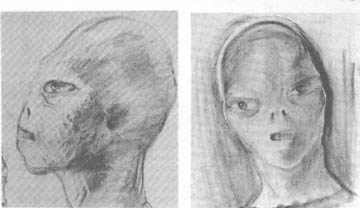
As an example take those Roswellians. They are short, skinny [poor musculature?], have large eyes, large heads, small noses and lipless mouths. What does that say about the planet they evolved on?
I am unaware of any UFO "Researcher" that has ever bothered to answer that question. Answer the question and you may begin to have an understanding of the purported ET's native environment and maybe even the type of star which their home planet orbits. [That is if they are not imaginary!]
Is the reason this has never been addressed is that too many "researchers" are wrapped up in the "Religion of Conspiracy Theory" that science and rational inquiry have fallen by the wayside? That is the way it appears.
Instead of asking "scientific" questions, "UFO research" has boiled down to either adamant denial that UFOs or their passengers exist OR beating the dead horse of Roswell for nearly 70 years.
So now that you have the data and tools what are you going to do with them?
Oh... here's an odd question for you to consider: Why did the U.S. Air Force want to know what type of planet was habitable for humans in the early 1960s and paid the RAND corporation to tell them? RAND was then a government owned think tank. We were just beginning the space program... Why look at stars for habitable planets which are literally TRILLIONS of miles away? Was Dole's report a kind of technical "$500 toilet seat" or did the Air Force actually have a need for that specific information? If so, what was the need?